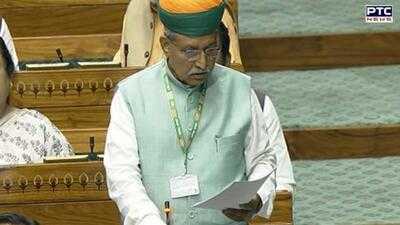
PTC Web Desk: Union Law Minister Arjun Ram Meghwal on Thursday informed the Lok Sabha that the Centre is considering a significant expansion in parliamentary representation, proposing a 50 per cent increase in seats across all states. If implemented, the total strength of the Lok Sabha would rise to 815 members.
Out of these, 272 seats are expected to be reserved for women, marking a major step towards enhancing female representation in Parliament.
The announcement came as the government introduced three major bills during the ongoing special session of Parliament. These include a constitutional amendment linked to women’s reservation, a delimitation bill and legislation concerning Union Territories.
While Meghwal tabled the constitutional amendment and delimitation proposals, Union Home Minister Amit Shah introduced the bill related to Union Territories.
The special session, scheduled for three days, follows the conclusion of the Budget Session earlier this month. The Centre appears keen to build momentum around electoral and structural reforms, including the long-pending issue of women’s reservation.
Prime Minister Narendra Modi is also expected to address the Lok Sabha, with indications that the government may seek broader political consensus on the proposed reforms.
The ruling NDA government has reiterated its support for implementing the women’s quota, arguing that the demand has been pending for decades. Although a women’s reservation bill was passed unanimously in 2023, it has yet to be operationalised. The fresh proposal aims to link its implementation with delimitation and the redrawing of constituencies based on the 2011 Census.
However, the Opposition has raised concerns over the pace at which the government is moving. While broadly supporting the idea of women’s reservation, several parties have questioned the urgency, warning that hurried decisions could affect the balance of India’s federal framework.
The delimitation proposal has also triggered sharp reactions, particularly from southern states. Leaders from the region argue that revising seat allocations based on population could penalise states that successfully implemented population control measures in previous decades, potentially reducing their representation in Parliament.
The developments have set the stage for intense debate in the coming days as Parliament takes up these crucial reforms.
Contact to : xlf550402@gmail.com
Copyright © boyuanhulian 2020 - 2023. All Right Reserved.